
Allen County Civil Docket Searches
Indiana MyCase is the free public doorway to nonconfidential Odyssey cases. Pick Name for a person or business. Pick Case when you already hold a cause number. From there, select Allen County and the Civil category. A full case number works best. Name searches can filter by first, middle, business name, status, and file date. Skip the birth-date filter in civil matters. The field is often blank, and the filter hides those cases entirely.
MyCase stops at 1,000 results. Narrow a common name rather than trusting the first list. A wildcard after a name prefix helps; sounds-like matching catches some misspellings. The two tools cannot combine. The Allen Clerk site simply links to MyCase. There is no separate county database to try.
- Open MyCase and select Civil.
- Choose Allen County.
- Search by cause number, party, business, or attorney.
- Compare court, case type, status, and file date.
- Read the newest CCS event and request official copies if needed.
Allen Civil Case Codes
Allen County civil court dockets arrive sorted by code, not as one long list. Indiana case-type codes flag the kind of dispute and separate cases with similar captions. PL means civil plenary. CC covers civil collections. CT marks civil tort, MF mortgage foreclosure, SC small claim, and EV eviction. Family matters use DC and DN. Probate and guardianship carry their own codes, and protection orders get distinct access treatment.
- PL
- A broad civil plenary matter.
- CC
- A civil collection case.
- CT
- A civil tort action.
- SC
- A small claim.
- MF
- A mortgage foreclosure case.
That code sits inside the cause number and the public case header. Treat it as a search filter, nothing more. It says nothing about who won.
Civil Dockets: What They Show
Open an Allen County civil docket and you get the basics first: cause number, assigned court, case type, file date, status, caption, and each party's role. From there the CCS tracks the life of the case. Complaint, summons or service events, appearances, answers, motions, proposed orders, entered orders, hearing settings, judgments, and enforcement work all appear in order. A document image may attach to an entry. Not every event has one that the public can open.
| Cause number | Indiana identifier with county, court, year, type, and sequence components |
|---|---|
| Parties | Plaintiff, defendant, petitioner, respondent, or another role |
| CCS events | Dated filings, notices, hearings, orders, and rulings |
| Status date | Date the displayed case status last changed |
| Judgment | The entered result, distinct from a proposed order |
The public MyCase interface shows the civil search fields.
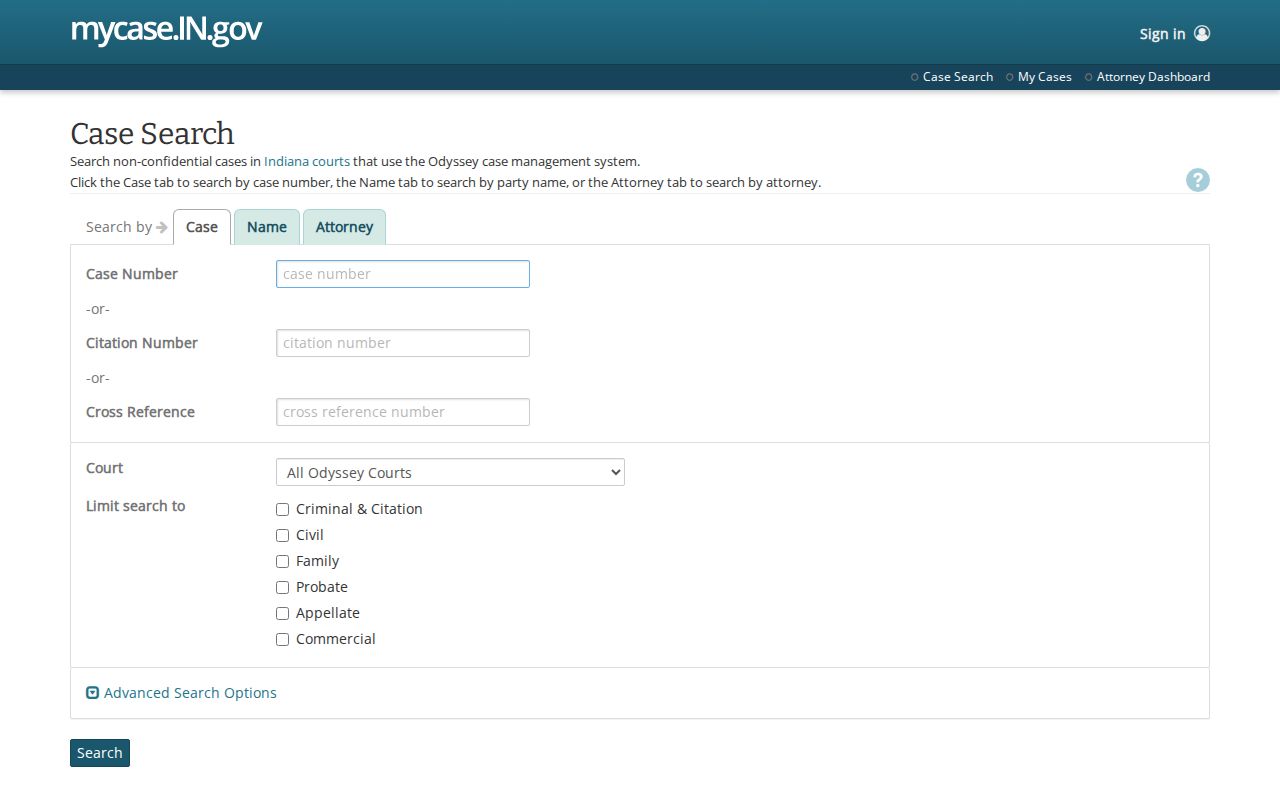
This is why the right category and court filters sharpen a civil lookup.
Allen Service Through Judgment
Read the civil chronology as a chain, one link at a time. Filing opens the matter. Service entries show delivery happened, not that the claim is true. An answer or appearance means a party showed up. Motions are requests. A proposed order is just a submission. It becomes a ruling only when the judge enters the order.
The CCS can keep running after judgment. Proceedings supplemental are post-judgment enforcement, and garnishment reaches out to a garnishee. Neither one is a new decision on the original claim. Whatever order was entered last controls the current procedural picture.
What Cases Fill the Civil Docket
Allen Circuit Court and the Allen Superior civil judges divide the civil work. Local assignment rules govern the split. The public categories include contract and collection claims, tort matters, property and mortgage cases, small claims, evictions, domestic relations where public, probate, guardianship, and miscellaneous civil filings. Confidentiality varies by record. A public family or probate header does not put every document online.
| Allen case group | Typical docket focus |
|---|---|
| Plenary and tort | Complaint, service, motions, discovery events, trial, judgment |
| Collections | Claim, answer, default or judgment, enforcement |
| Small claims | Claim, service, hearing, judgment |
| Family and probate | Orders and settings subject to access limits |
Allen County's FAQ puts the small-claims threshold at $10,000. Confirm the current filing route and fee with the Clerk before you file.
Allen Civil Fees and Copies
The Clerk's July 2025 case-type schedule gives sample costs: $157 for civil collection, $232 for plenary or tort, and $87 for an electronically filed small claim. Filing costs are one thing. Pulling an existing docket is another. Confirm the current category and any additions before filing anything.
The Allen Clerk fee page carries the live schedules.
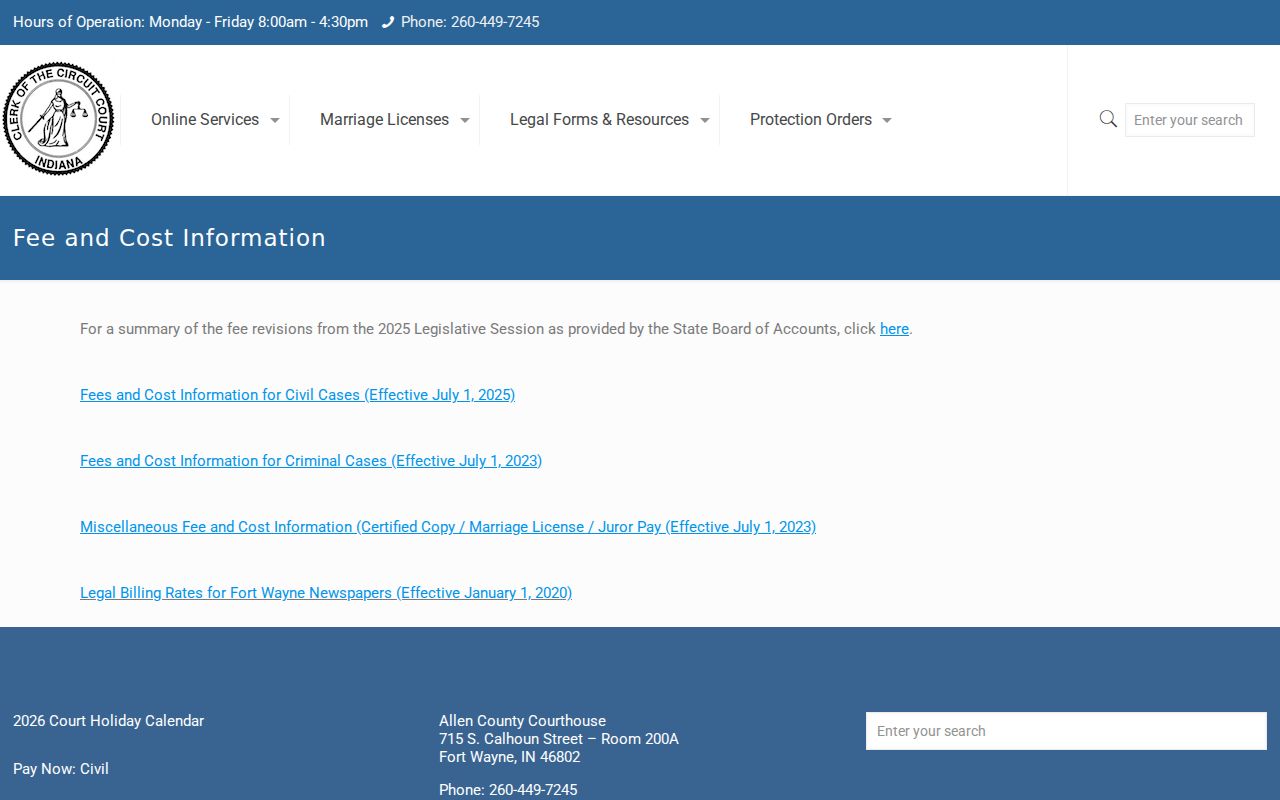
The page splits filing costs from copy and certification charges. Existing court-record copies run $1 per page, plus $3 per certified document. Ask for a quote on large, historical, or exemplified files.
Hearings on the Civil Docket
A Allen civil setting might be a case-management conference, motion hearing, default-judgment hearing, damages hearing, proceedings supplemental, garnishment hearing, pretrial conference, or trial. The Court Calendar shows hearing date, time, court, judge, and location for a short rolling window. The CCS holds the longer chronology.
A hearing on the calendar is not a result. If the event is continued, the old date stays put. A later entry supplies the new one. Check the newest CCS setting against the Allen County court schedule. Then call the assigned division when the two disagree.
Allen Civil Copy Requests
Civil copy requests go to the Clerk's Central Services Division. That office sits in Room 201, 715 South Calhoun Street, Fort Wayne. The same office takes requests by mail. Email copyrequest@co.allen.in.us, or use the online form. The copy phone is 260-449-7890. Published copy hours run Monday through Friday, 8:00 a.m. to 4:00 p.m.
Give the office what it needs. List the parties, cause number, document name, filing date if known, number of copies, and whether you want certification. Mailed requests take a check or money order payable as the Clerk directs. Add a return envelope too.
The Clerk copy page explains the route.
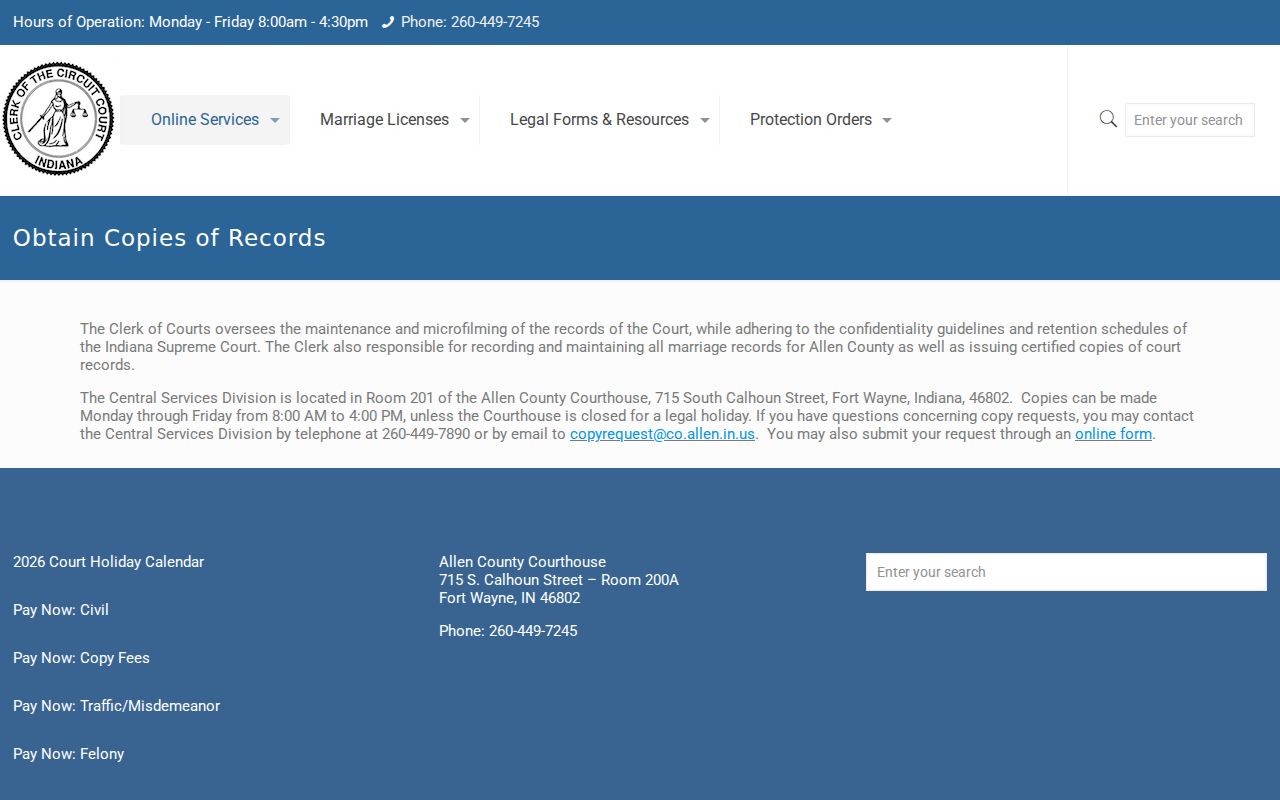
Use that official copy route whenever MyCase lists an event but no document image.
Who Can See Civil Dockets
Indiana Rule on Access to Court Records 4 sets the starting point for public access. Rule 5 then carves out exceptions. Confidential cases include juvenile matters, adoptions, mental health filings, protection orders, and sensitive family material. Rule 9 gives you a way to ask a judge. You can ask permission to see an excluded record. The county APRA portal sits below these court rules and cannot loosen or tighten them.
Missing is not the same as nonexistent. A sealed or confidential Allen County civil docket may show only a public indication, or may not appear in an ordinary MyCase search.
MyCase itself cautions that older, converted, or unlinked documents can show up incomplete online. The Allen Clerk holds the official file, so ask there rather than assuming access will be granted.
Federal Civil Cases in Fort Wayne
A federal civil case never lands on an Allen County state civil docket. It belongs to the Northern District of Indiana. Its Fort Wayne Division keeps its own federal clerk and runs on PACER. Federal fee policy allows PACER charges. Courthouse terminals and exemptions follow federal rules. PACER publishes its current pricing rules on its official page.
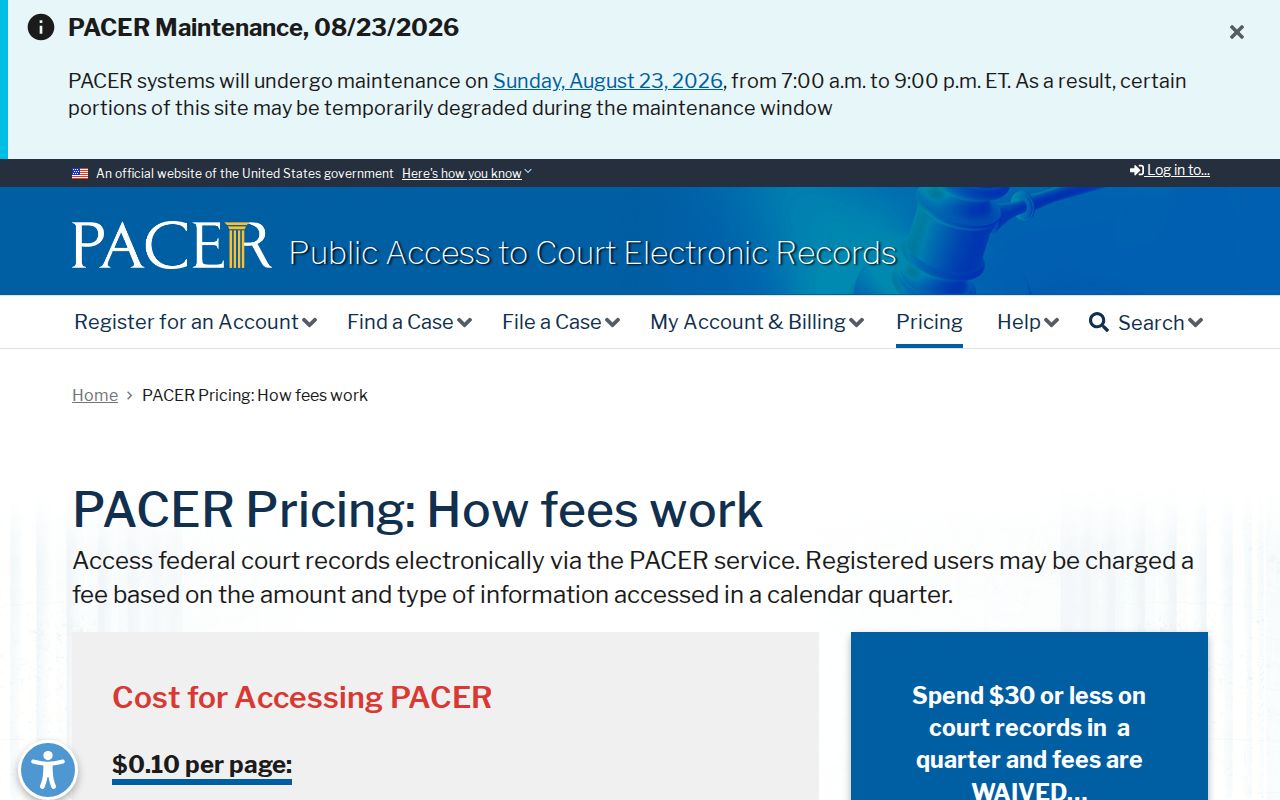
That official pricing page makes clear PACER is a paid federal product, separate from Indiana's free MyCase.
Allen County Civil Docket Notes
Keep the cause number, assigned court, and civil type code. Add the status date, newest CCS event, next hearing, and requested document title in one place. This separates a filing from an entered order. It does the same for a scheduled hearing and a completed one. The list also lets the Allen Clerk pull a copy without an open-ended file search.
Older Allen County civil court dockets can carry converted events or lack public images. The chronology may cite an order you cannot open. Request that exact order by title and date. A missing image does not mean a missing filing. And remember, a proposed order is not the judge's ruling until the court enters it.
Mail requests should include payment and a self-addressed stamped envelope. The Clerk publishes no standard turnaround. Call 260-449-7890 before sending any large, historical, or specially certified request. That way Central Services can confirm cost and format.